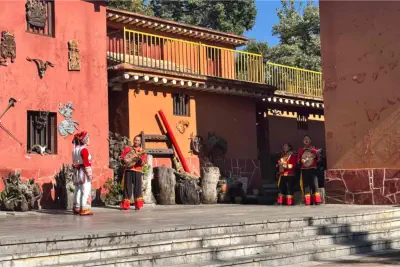
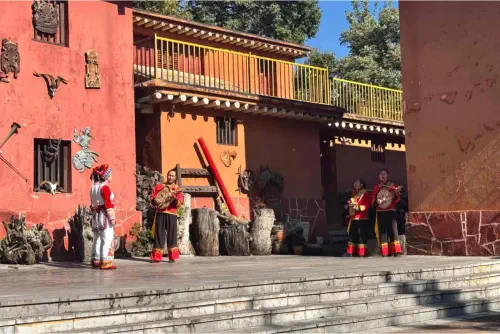
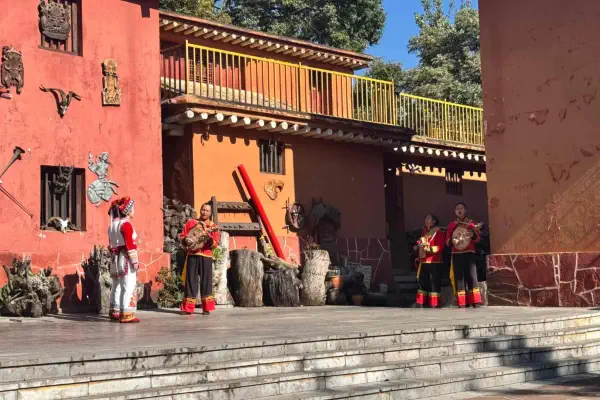
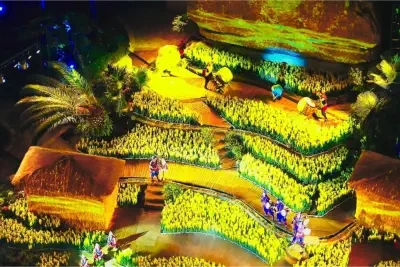
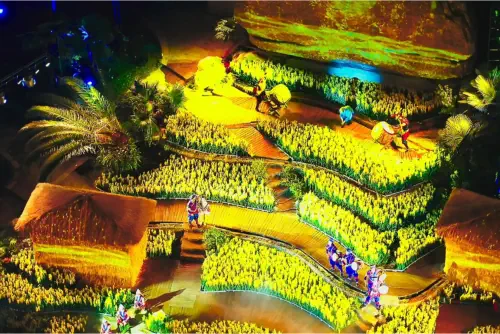
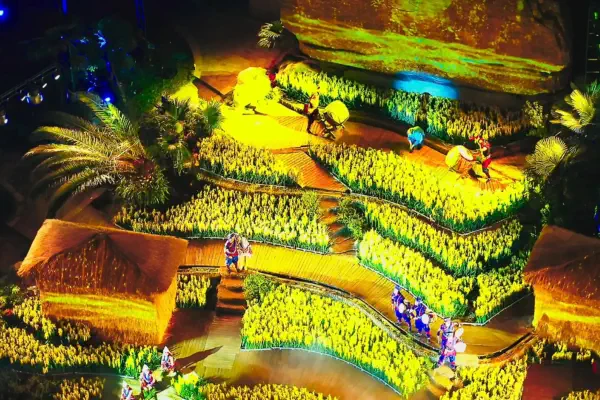
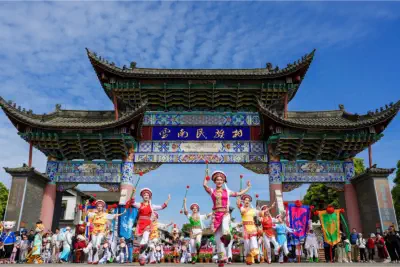
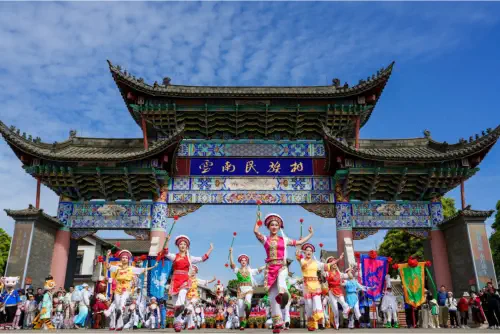
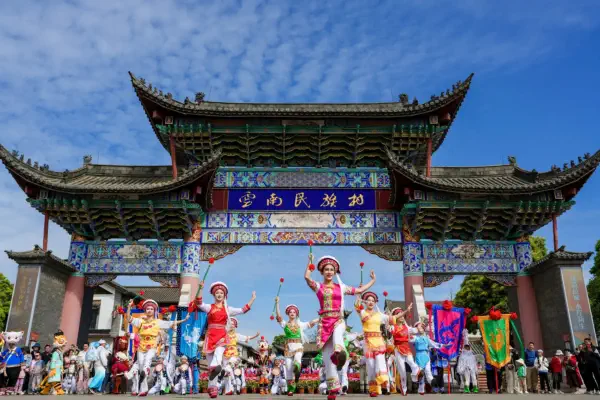
The village was designed to showcase not only the cultures of the 26 minorities, but also the beautiful natural landscapes of the area.
The village consists of many smaller villages representing the different cultural groups. It covers an area of 84 hectares (208 acres), including 31 hectares (76 acres) of water.
It offers shows and singing and dancing performances, folklore and wax museums, and replicas of the kinds of buildings found in the villages of each ethnic group, including the Bai, Buyi, Dai, Lahu, Miao, Naxi, Pumi, Shuyi, Tibetan and Yi. There is a tremendous range of styles of ethnic handicrafts, jewelry and clothing on sale.
Set in a beautiful environment of lofty hills, shining pools, traditional houses and colorful and rare plants, the Yunnan Nationalities Village showcases the architectural styles, religious beliefs, and folk customs of all the ethnic groups in detail. Visitors can see the various architectural styles, different modes of dress and distinct customs of the great variety of cultures in Yunnan.
Visiting the village during one of the festivals provides an extra dimension of pleasure. Some of the notable festivals that are celebrated in the village include the Water-Splashing Festival of Dai minority (April 13-16), the Torch Festival of Yi minority (June 24 in the lunar calendar), the New Rice Festival of Jinuo minority, around the end of July and the beginning of August, and the Third Month Fair of the Bai people in late April.
Main attractions Yunnan Ethnic Village
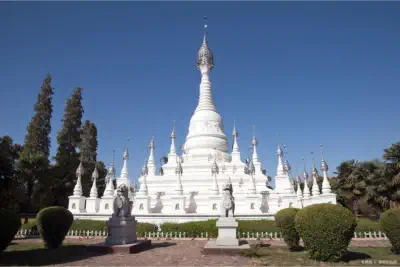
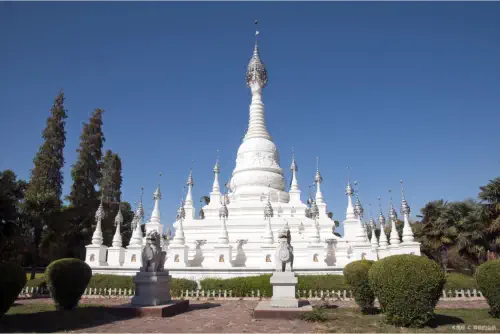
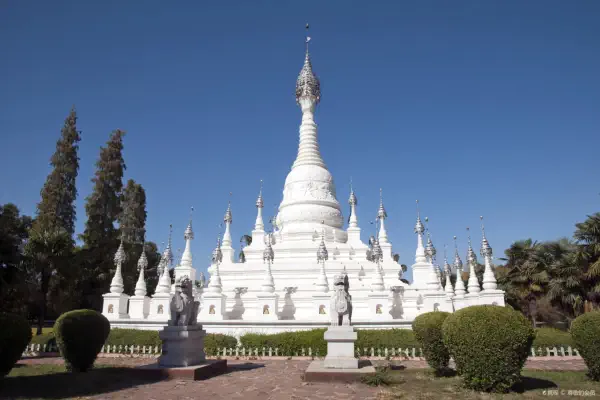
Dai Village is the first village to enter the ethnic village, covering an area of 27 acres, surrounded by water on three sides and hidden by green trees. The "dry railing" Dai family bamboo buildings are connected to the solemn Burmese Temple through the winding red sand and stone paths. The majestic white pagoda, the exquisite wind and rain bridge, as well as the wind and rain pavilion, well, bell pavilion and other buildings are full of the strong style of the Dai family, which is the real folk landscape reproduction of Dai Village.
The Shui village is built on the water, surrounded by agricultural tools, mainly composed of the representative board house "street house" style buildings of Gugan Shui Township, Fuyuan County, Yunnan Province, as well as the combination of Bagua Wheel, Longtan, Dalongshu and other landscapes, expressing the ancestral style and characteristics of Shui culture.
The Buyi village is built by the water, and the two houses are loyal to the folk construction method, realizing the perfect combination of the Qiong cage system and the board house construction method. The water pavilion corridor in the village and the winding path are not only a condensation of residential style, but also a new creation of garden landscape, which is quite representative.
The Bulang Village is adjacent to the Wa Village, and there are houses, ghost squares and other buildings in the village. The Ghost and God Square expresses the Bulang people's view of animistic nature, and the totem of the Bulang people is erected in the center of the square, and at the same time, the square is also an important place for the Bulang people to worship gods, perform songs and dances, and hold traditional folk activities.
Miao villages choose mountains to create an environment, which is quite representative; With the typical prefabricated house "stilt building" and other houses as the main body of construction, the essence of Miao architecture is refined. The stilt building displays Miao costumes and handicrafts, while the residential building reflects the style of daily life.
Dulong Village is centered around a typical plank house with wooden beam residential buildings. A mother and her child moved in, presenting a true picture of human life. At the same time, a treehouse building was created, thus recovering a trace of history.
The Pumi village is mainly based on the typical "stacked wood" double-storey residential style, which is surrounded by courtyards in folk ways. Crispy Lima wine is mainly made of barley and brewed according to the local method, which has always had the reputation of "local beer", and the Xitou building has created the style of Crispy Lima "workshop".
Nu Village is mainly based on typical stone slab houses with stone slabs and tiled roofs, or through the hall, or connected to the suite, and the stone steps on the terrace are calmly embellished, fully expressing the vivid spatial composition of Nu architecture, as well as the combination of creating the integration of humanities and nature.
The Lisu village is based on the typical board house "thousand feet to the ground" residential building, which expresses the modeling characteristics and combination form of the Lisu folk terrace environment, and shows the aesthetic taste and open-minded lifestyle of the Lisu people from one side.
The Manchu courtyard draws on the construction method of the Manchu residential compound in Benxi in the northeast, and at the same time injects a large number of elements of Kunming courtyard architecture, so it should be the perfect combination of residential architecture in the two places.
The Hui village in the Ethnic Village Scenic Area is mainly composed of residential buildings, a mosque, and street complexes, with landscaping and horticultural features interspersed throughout, more fully reflecting the layout style and construction characteristics of Hui architecture in Yunnan.
The Yao village is composed of residential hanging corner buildings, bungalows, rural Taoist temples, granaries, village gates and other buildings, which are staggered; The infiltration of some Taoist cultural elements is quite typical.
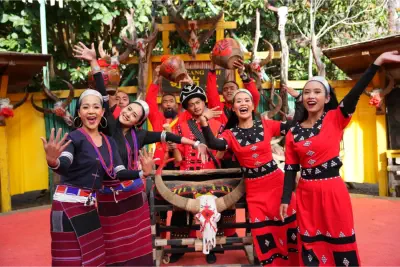
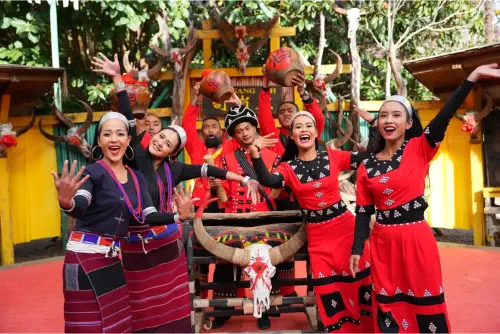
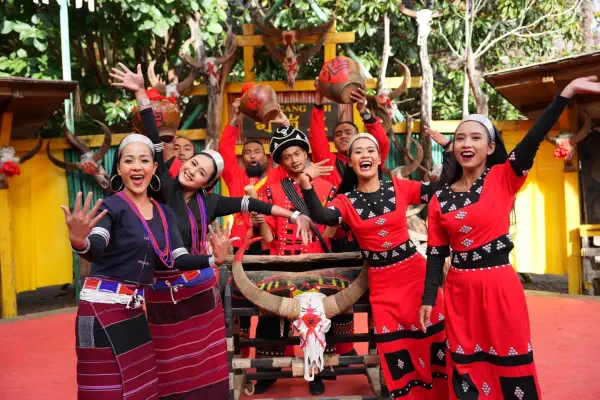
The Lahu village is closely connected to the Jino village. Within the village, there are Lahu thatched houses, communal houses, a church, cattle pens, and the Gourd Square. Located at the center of the Lahu village, Gourd Square is shaped like a huge gourd from a plan view, with a group of stone-carved gourds at its core. According to legend, the ancestors of the Lahu people were born inside a gourd, so Gourd Square reflects the Lahu people's ancestor worship beliefs.
The Wa village is located in the southeast corner of "Cuiyizhou". There are thatched-roofed dry rail buildings, Niutou Square, God Square, Sigangli stone carvings and granaries. Niutou Square is an ancient place for Wa cattle hunting, the horn in the middle of the field is the Wa people's stakes, and the two stone figures in front of the square are the male and female ancestors of the Wa people. The Divine Square expresses the Wa people's concept of nature worship that all things are animistic and the soul is immortal. The two stone statues in the field are "Mu Yiji" and "Ayi'e", which are most worshiped by the Wa people.
The Jino village is connected to the Wa and Bulang villages by a bridge, facing each other across the water. Entering the Jino village, you can see jagged rocks scattered among lush green trees and flowers, and the Jino thatched houses are arranged in an orderly yet staggered manner, as if walking into the undulating mountains of the Jino region. The Jino village has large communal houses for the Jino people, residential buildings, granaries, and a Sun Plaza.
The Mongolian village is mainly composed of representative courtyards in the 'single seal' style of Xingmeng Mongolian Township in Tonghai, Yunnan, along with yurts and horse-racing grounds. It not only reflects the ancestral characteristics of the nomadic people of the great grasslands, but also showcases the unique architectural style of the Mongolian people in Yunnan.
The Bai village covers an area of 62.5 mu. The village is mainly composed of traditional Bai-style residences featuring flying eaves and dougong brackets, with carved beams and painted rafters. The layout includes 'Three Lanes and One Screen Wall,' 'Four Courtyards and Five Wells,' a Tie-Dye Workshop, a Wood Carving House, a Garden Teahouse, a Theatre Stage, the Ancestral Temple, and a fourfold scaled-down model of Dali's 'Three Pagodas of Chongsheng Temple,' making the village courtyard orderly and spacious. A street called 'Dali Street,' which sells exquisite industrial products, runs from north to south, with a Folk Customs Museum and a Butterfly Exhibition Hall along the street.
In the Zhuang village, facing you are dragon pillars used to worship the Dragon King, with cliff paintings of heavenly kings drawn by the ancestors on both sides and a stone gourd pavilion built to commemorate assistance given to the villagers during the legendary flood. The Haotian Pavilion dedicated to the Jade Emperor and a huge bronze drum, said to drive away evil and bring blessings, rise on either side of the square. Stilted and hemp-fenced residences, the 'Loving Gallery' where Zhuang youth socialize and relax, the 'Elders' Pavilion' where village elders hold meetings, along with Dragon Trees and the 'Three-Seven' Garden, and further away, a unique Wind and Rain Bridge and a rotating waterwheel, all together portray a picturesque pastoral scene of the Zhuang homeland.
Mosuo dwellings are built using locally sourced materials, stacking logs horizontally to form walls, creating courtyard-style village houses. This type of well-structured building, also known as wooden beam houses, has good insulation and cold-resistance properties, reflecting an ecological view that aligns with nature. The Mosuo people have preserved the basic form of the matriarchal extended family. What you see is a complete Mosuo family's courtyard, consisting of the main house, Jing Hall, flower house, gatehouse, and other structures. The main house faces south, commonly called the Grandmother's Room. It houses the eldest woman of the family and serves as the core place for the entire family's meals, entertaining guests, holding discussions, and communicating with the spirits. The flower house, called the A Xia room, is the residence for marriageable women, one room per person, used for the practice of walking marriages. The Jing Hall is a place for Buddhist worship and conducting Buddhist ceremonies. Inside and outside the Mosuo courtyards, young women sing and dance, serve butter tea, ride pig trough boats, and sing 'Madami,' fully showcasing the customs and local culture.
The Naxi village covers an area of 49.5 mu. At the entrance, there is a statue of the Naxi protective deity 'San Duo' and a large relief wall themed on the 'Book of Genesis.' Important buildings characterized by bold paintings and exquisite woodwork, such as the 'Three Workshops and One Screen Wall,' 'Residential Courtyards,' 'Hua Ma Gate,' 'Crafts Building,' and 'Corridor Rooms,' enclose and highlight 'Sifang Street.'
The Yi ethnic village covers more than 50 acres. The three-tiger relief wall and the tiger-headed ancestral master figure reflect the Yi tiger-eagle culture. The solar calendar plaza has a totem pole featuring images of the sun, tiger, fire, and the Bagua, surrounded by 10 moon-shaped structures facing different directions, with stone carvings of the 12 zodiac animals on the outer circle. Built along the mountains are the 'Earthen Chief’s House' song and dance hall, residential houses, soup pot workshop, weaving and embroidery rooms, as well as the Tusi Courtyard, all showcasing ecological harmony. The village also has a bullfighting arena, a tea garden, and folk sports facilities such as swings.
Hani Village covers an area of 15 mu, showcasing the most representative mushroom houses and the mother-and-child Ai'ni houses, as well as Sun and Moon Square; there are large reliefs depicting the Hani legend of fish giving birth to all things, totem poles representing the Hani migration legend; there are facilities reflecting daily life, such as a mill, Longba Gate, swing ground, and terraced fields; the village's sacred tree and sacrificial stones illustrate the Hani people's religious beliefs of 'all things have spirits, polytheism.'
The architecture of De'ang villages includes De'ang large houses that can accommodate dozens of people, small houses with felt hats roofs, as well as the rather romantically styled large public houses and small public houses... There are also the 'Longyang Tower' landmark and Buddhist monk quarters, and pagodas.
The Jingpo Village in Yunnan Ethnic Village covers an area of 15 acres and features spacious and elegant various residential buildings and exquisitely luxurious 'mountain official houses.' The architectural forms collectively reflect the Jingpo people's 'stilted' and 'inverted T-shaped' structural characteristics and layout patterns. In the center of the square stands a 'Mu Nao Zong Ge Shi Dong.' The patterns and sculptures symbolize the Jingpo people's desire for unity and progress, as well as their brave and resolute character. The Jingpo people follow a primitive religion that believes all things have spirits, worship ghosts and deities, and honor their ancestors.
The Achang ethnic village is centered around a compound courtyard building, which corresponds with the village gate, handicraft workshops, and other structures. With blue-tiled brick walls and stone base columns, it is quite distinctive.
The Tibetan village covers an area of 21 mu. Within the village, there are sloped-roof residences from the Zhongdian area and carved flat-roof residences from the Deqin area. The solemn and sacred Tibetan Buddhist temples, the magnificent welcoming white pagoda, the “white yak” sculpture symbolizing auspiciousness and harmony, and the uniquely styled Tibetan architecture complement each other, enhancing each other's charm.
Location/Address
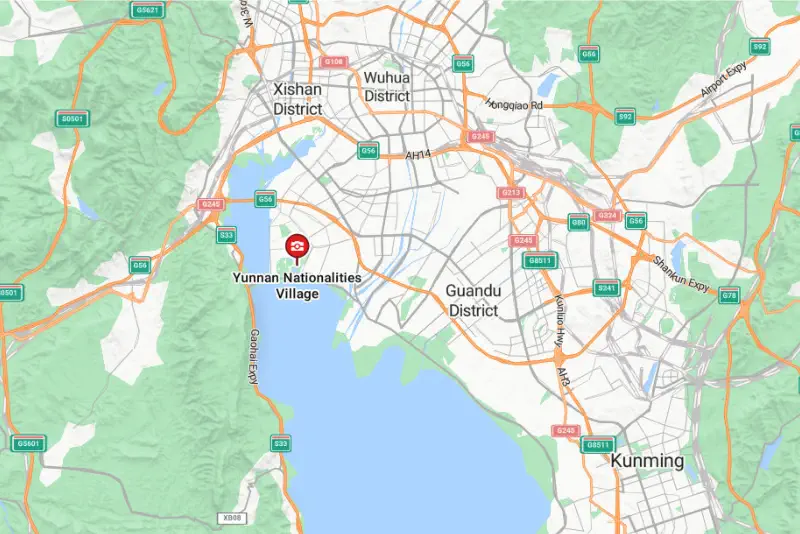
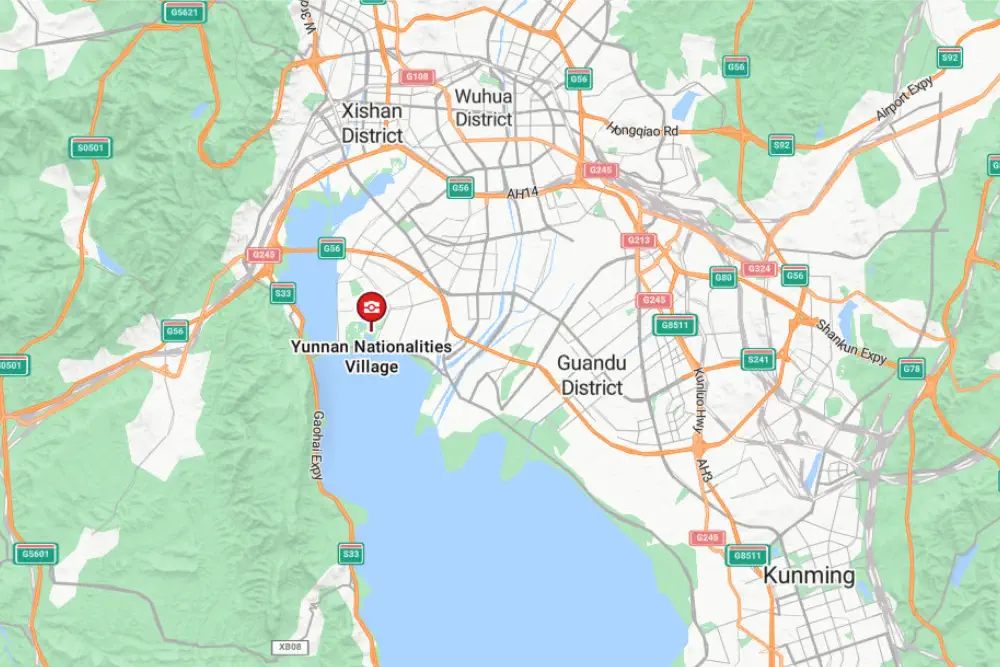
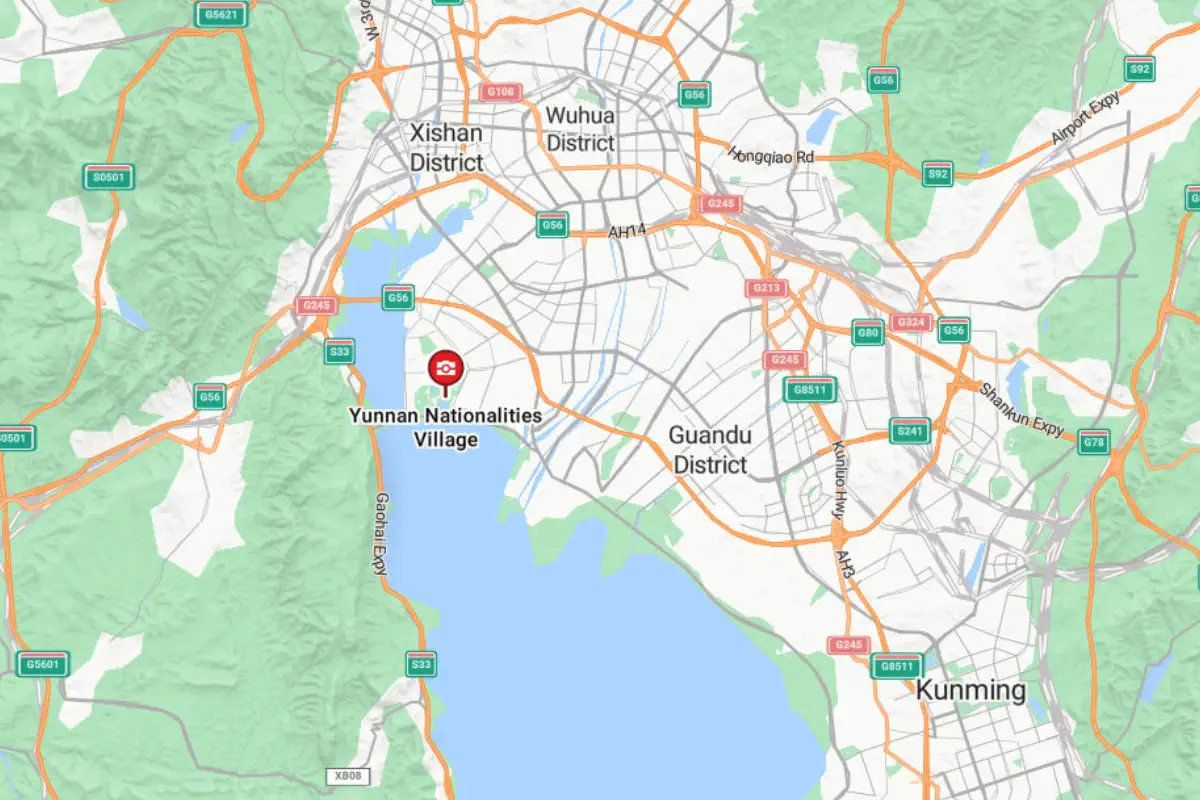
No. 1310, Dianchi Road, Xishan District, Kunming City, Yunnan Province, China
Travel Tips
The Yunnan Nationalities Village is open daily 9 am-6 pm. You can reach it by taking bus 24/44 from Kunming Station or bus 7 from downtown Kunming city. If you take one of the bus lines numbered 73, 94, 135, 165, 172, 184, 233, A1, A4, or A9, get off at (Yunnan Minzucun) Yunnan Nationalities Village station. The village is near the Western Hill Forest Park and Dianchi Lake on Yunnan-Guizhou Plateau, the village is 10 kilometers (6.2 miles) from Kunming. There are hotels near the Yunnan Nationalities Village in the area near Dian Lake, including the Kunming Redolence Garden Boutique Hotel, the luxury, five-star HUALUXE Hotels & Resorts Kunming and the T&T Story Hotel (Nationalities Village). The Kunming Uchoice Hotel and the Enjoying International Hotel are both convenient for downtown Kunming.